4. PyTorch_BoilerPlate Reduction
Building a Neural Network with nn.Module
Currently what we do is that we declare a layer like this
W = torch.tensor([
    [1.0, 2.0],
    [2.0, 1.0],
    [1.0, 1.0]
], requires_grad=True)
But it is shitty approach. We can declare a Neural network layer in better way using pytorch's own implementation
W = nn.Parameter(torch.tensor([
    [0.5, 1.0],
    [2.0, 0.3],
    [1.5, 2.0]
]))
| Feature | torch.tensor(..., requires_grad=True) | nn.Parameter(...) |
|---|---|---|
| Stores gradients | ✅ | ✅ |
requires_grad=True | ✅ | ✅ Automatically |
| Trainable model parameter | ❌ | ✅ |
Appears in model.parameters() | ❌ | ✅ |
| Optimizer automatically updates it | ❌ | ✅ |
| Now |
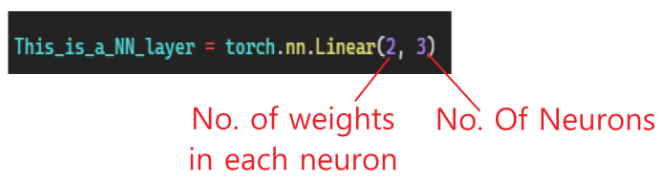
In case we want to simply initialize a random layer with a particular number of neurons thats even easier
This_is_a_NN_layer = torch.nn.Linear(2, 3)
Building Same neural network but with NN.Linear
import torch
import torch.nn as nn

x = torch.tensor([2.0, 3.0])
target = torch.tensor(20.0)

# 2 inputs → 3 hidden neurons
hidden = nn.Linear(2, 3)

# 3 hidden outputs → 1 output neuron
output = nn.Linear(3, 1)

learning_rate = 0.001

for step in range(1000):
    # Forward pass
    z = hidden(x)
    a = torch.relu(z)
    y = output(a)

    # Loss
    loss = (target - y) ** 2

    # Backpropagation
    loss.backward()

    # Parameter update
    with torch.no_grad():
        for parameter in list(hidden.parameters()) + list(output.parameters()):
            parameter -= learning_rate * parameter.grad

    # Clear gradients
    hidden.zero_grad()
    output.zero_grad()
Pytorch Loss Function
Earlier Loss Approach
1- We used to Calculate loss like this , By directly calculating loss inside the training cycle
loss= (target - y) ** 2
2- And within training cycle we would send loss back to gradients like this
loss.backward()
New Loss Approach
1- But now we have a selection of loss calculating algorithms by just using pytorch loss object and selecting desired loss function, also this is outside training cycle means its more plug and play from outside.
loss_function = nn.MSELoss()
2- Then we calculate loss within training cycle just by calling this object
loss = loss_function(score, target)
3- Finally we Send the loss as gradients to each of the parameters
loss.backward()
Pytorch Optimizer Selection
Earlier Optimizer Approach
1- We used to optimize like this , Manually setting all the values
with torch.no_grad():
W -= learning_rate * W.grad
b_hidden -= learning_rate * b_hidden.grad
w_output -= learning_rate * w_output.grad
b_output -= learning_rate * b_output.grad
New Optimizer Approach
With Pytorch we simply make a optimizer object along with the learning rate
optimizer = torch.optim.SGD(
    neuralnetwork.parameters(),
    lr=0.001
)
Then we set that optimizer does not change the gradients itself within the training loop
optimizer.zero_grad()
Then we calculate gradients using loss function and all but when time comes for changing values we simply do
optimizer.step()